
By Herb Weiss, contributing writer
Democratic gubernatorial candidate Helena Foulkes and independent candidate Ken Block squared off Friday, Oct. 2, at a gubernatorial candidate forum focused on issues affecting older Rhode Islanders, people with disabilities, family caregivers, and those receiving behavioral health services.
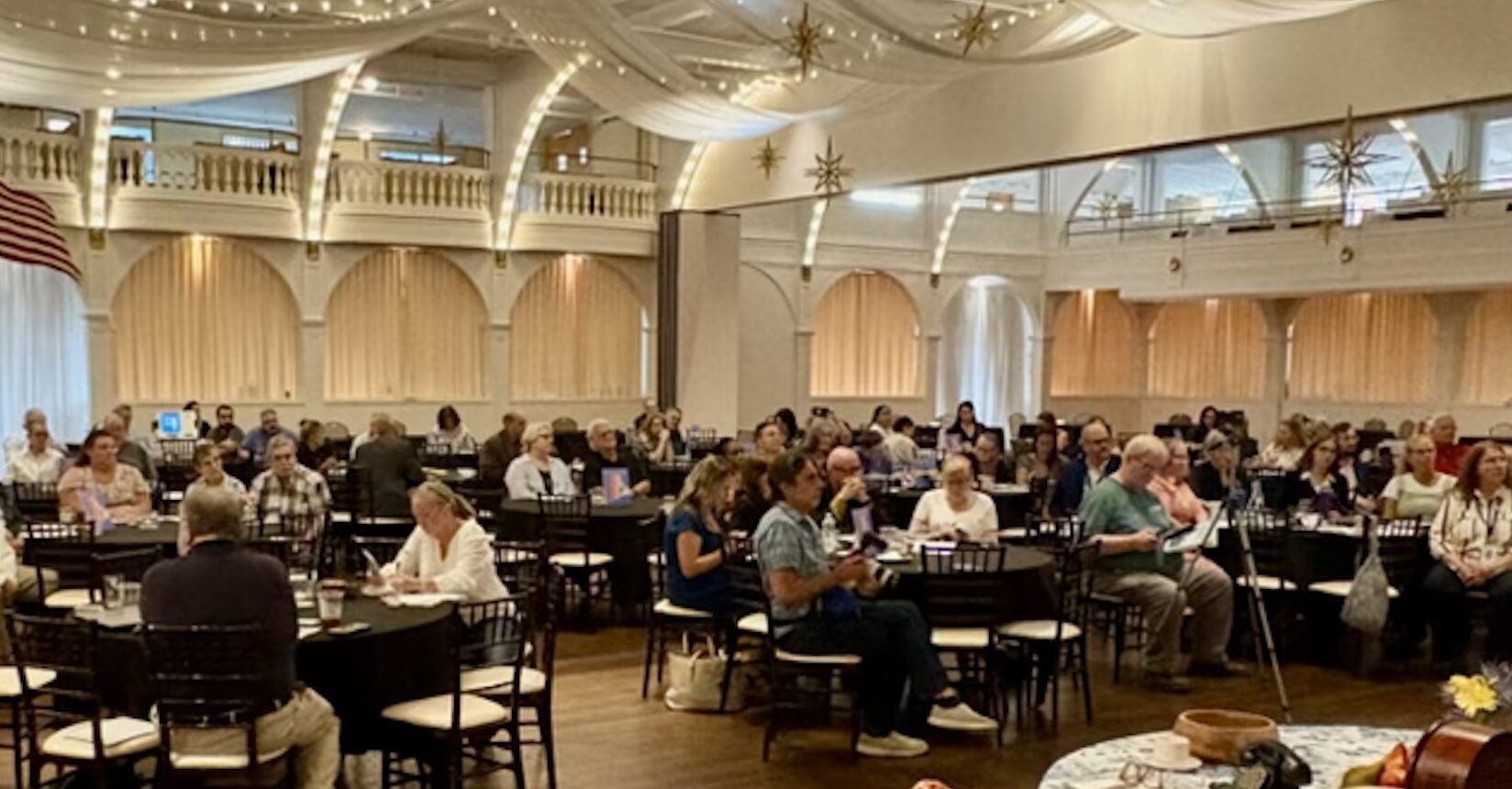
The forum, held at Rhodes on the Pawtuxet in Cranston, was sponsored by the Senior Agenda Coalition of Rhode Island, AccessPoint Rhode Island and the Mental Health Association of Rhode Island.
Unlike many gubernatorial forums that focus heavily on taxes, housing, education and the economy, this forum allowed the candidates to address issues that often receive less attention during political campaigns: aging in the community, long-term services and supports, nursing home care, Medicaid, family caregiving, behavioral health and services for persons with disabilities.
Here is a video of the forum, courtesy Pat Ford, The Coalition Radio Network. Following the video is a “transcript” of the questions and responses.
The questions and candidates’ responses have been edited for length, grammar, and clarity. The meaning of the questions and candidates’ responses has not been changed. Refer to the video, here, for more information.
“Before we begin, you’re all entitled to know that Aaron Gukian committed to taking part in this forum. He accepted my invitation and we planned this program around his participation. He is not here today. I received a phone call at 3:00 PM that he would not be here. I’m not going to let that take time away from this value forum. We’ve adjusted the program, and we will move forward in a focused and streamlined way so that these candidates who have taken the time to be with this audience get the forum they deserve. But you should know he did make a commitment to this community and he did not keep it.”
Here is what Foulkes and Block told more than 80 attendees at the forum.
Opening Remarks
I really wanted to thank the Senior Agenda Coalition for pulling this together, the Mental Health Association of Rhode Island, and AccessPoint Rhode Island for all you do.
I want to say that I feel very strongly that the senior population in our state is an incredibly untapped resource.
The wisdom, the expertise—and we’re going to talk a lot tonight, I’m sure, about taking care of many of the elder folks and others in our state who need our support. But I think we often forget how much wisdom exists and how much more we could benefit as a state by tapping into all of your expertise.
I am very excited to be looking to the senior community to help me think about things like a Senior Corps-style effort. How do we take, as I said, the wisdom and expertise and tap into your sense of volunteerism?
I’ve been crisscrossing this state for the last few years, mostly in people’s kitchens and living rooms, listening, showing up, and asking people, “What’s one thing you’d love the next governor to do for you?”
I’m very happy to be here tonight. Helena and I have been in front of many forums this year, hosted by advocacy groups for different purposes, all providing services or looking out for the interests of different groups of people.
This group has been remarkably effective at educating me about their issues and talking to me about the challenges that different groups of people experience as they age.
I have been on this journey with my parents as they’ve aged and passed away. My wife’s parents are now in their 80s and are experiencing a very different journey than my parents did. They’re aging in place, let’s say, challengingly.
Dealing with that remotely has been a challenge for both my wife and me. It makes me realize that while my parents and Jen’s parents have been really supported, others on the journey don’t have the level of support and family involvement we had.
That’s where groups like this, or advocacy organizations like the ones we have here representing different services that can provide the help people need, are so vitally important.
On this topic, I absolutely am open to the idea of a cabinet-level position. I need to understand it more closely, but I would say Maryland is a place where this does exist.
I’m good friends with Wes Moore. So this is an example where, using some of my relationships and even many other governors, I’d love to understand what does great look like as we think about serving the senior population.
I also want to speak to the fact that I think we need a whole-of-government approach. Tonight, it’s really hard to give you a hard commitment on dollars given that I don’t know what the state of the budget will be.
You look at education, DLT, RIPTA, lots of places where seniors—food—where seniors need access to support. And we’ve got to have, under my leadership, a government that is really focused on how we serve seniors in the state because, to Maureen’s point, it’s a huge portion of our population, higher than most other states.
I would also like to have a master plan on aging. I’m sure many of you have parts of that. I want to pull it together.
So that’s where we need a governor who will set the expectation that I want to see – a plan. I’ll have deadlines because I want to benefit from the expertise, as I mentioned, involving you. Still, I also want to make sure we have a plan where we can hold ourselves accountable to making seniors’ lives better.
Yes. I believe OHA should be a cabinet-level position for a simple reason: a substantial portion of our population has interests that line up directly under OHA.
And as governor, I want to make sure every large group of people who live here has a voice I can hear. Having OHA as a cabinet-level position gives me the ear I need to hear their needs.
I don’t disagree with anything Helena just said, but I would like to tackle the issue a little bit differently because I don’t think the state is being responsive enough.
I hear a lot of dismay and unhappiness with how responsive the state is to the needs of advocacy groups and the nonprofits that work with it. Several areas of dysfunction seem to be particular sticking points, especially OHHS.
So I describe myself as an operational manager. I’m a real specialist at understanding where an organization doesn’t work well, where the friction points are, and what changes we need to make to make it work better.
And I look at Rhode Island as a—right now, Rhode Island government’s kind of a target-rich environment.
I want to start on a human level around this question because I think the idea that more of our senior citizens should be able to live at home and have caregiving at home is a really great aspiration.
I think one of the barriers to this is having the kind of home healthcare workers that we need actually to support folks in the state.
I speak to a lot of caregivers who don’t even talk about the dignity of their own work, how challenging it is, how low-paid it is. Most of the people I speak to don’t even have healthcare insurance themselves.
So I think we need to start by understanding what the gap is to get to this target, what the gap is in terms of the number of community healthcare workers who can do these jobs, and how do we make sure more of them get trained up, paid appropriately so that we can really be providing service.
You have Donald Trump, who is now essentially targeting many of these home-care providers and healthcare workers by threatening to send immigrants out of this country.
And I’ll use the Haitian community as one example of that. An incredible community of hardworking, loving, dedicated healthcare workers who are now unsure whether they’ll be able to stay here.
Research shows that care for nursing home residents who need lower levels of care can be provided more cost-effectively outside nursing homes.
So from the governor’s office perspective, my job would be to make sure that we can pave the way for these alternative treatment and housing solutions, that they’re available, and that we can help families who might be taking on some of the burden of caregiving by providing resources to them to make the job easier.
As you all know, the state budget is under tremendous pressure, both from within and without. Washington, D.C., is threatening us. We have a structural deficit coming into this budget year, and Helena and I have both heard requests for what I estimate to be billions of dollars in additional funding this year from the different groups we’ve spoken to.
I have no idea how we prioritize all the different needs or how we can pay for them. It’s going to be very difficult.
But what you have done here, and what other groups have done, has demonstrated beyond a doubt that your requests are worthy.
What I’ll add to my last answer is the idea of helping families navigate the complexity of this and thinking about this concept of “no wrong door.”
The idea is that I could go to a website the state has and really be helped to figure out how my loved one gets the best level of care in the state.
It’s really hard right now.
And what I’ve always said in my career is I don’t need to be the smartest person in the room. You all know much more about this than I do.
But what I want to do is ask all of you, as it relates to something like this, what are all the stupid things we do? What barriers do we put in your way, and how can we make it much easier for families navigating the complexities of this issue?
With developmental disabilities, you have a challenge at some point where the severity of it is such that a home-based solution can be not only very difficult, but at times could also be maybe somewhat dangerous.
So I believe that the state government, the governor’s office, our job would be to make sure that people understand whatever services are available, whatever programs of support are available.
It’s a good idea when it works and as long as we can do it safely. And that would be my biggest concern, as long as everybody can be safe.
We know that moving eligible individuals out of group homes or institutional settings and into the home environment can often lead to better results.
The last couple of years, the drumbeat around healthcare has gotten really loud. People are really worried that their primary care doc is going to retire and they won’t be able to find anyone.
We have two hospitals in our state that are on life support, I would say: Roger Williams and Fatima. We made a deal to keep them alive earlier in the year, but there’s still a real risk in those hospitals.
We have the federal government, which is just ruthlessly attacking people around healthcare in this country, with 40,000 Rhode Islanders who are going to lose access to Medicaid starting in January.
It’s so cruel. It’s so inhumane.
So a big thing that I’ve been focused on, in all honesty, is: how do we make sure people don’t get kicked off of Medicaid?
I want to use the faith-based community. I want to use senior centers. I want to go into some of the high-rises where seniors are living and bring the paperwork and resources to people, because the really sneaky thing about Donald Trump and what he did with H.R. 1 is he’s making the paperwork so complicated that people won’t get through it and will give up.
I think healthcare will be the tsunami that will hit the next governor.
I’m really glad Rhode Island cannot mint its own currency, because it would let politicians overcommit.
One of the easiest things for someone like me sitting here facing a room with people like you, on every question that asks, “Can you fund us? Can you fund us? Can you fund us?” The simple question is always the simplest answer, and the one that, as a candidate, you want to say is, “I’ve got you.”
In this circumstance, I can’t tell you that I’ve got you. The General Assembly can’t tell you that they’ve got you. We don’t know what is coming at us.
So what I will tell you is I fully understand the need. I understand completely how important the program is. I get it. I really do.
But what I can’t tell you right now is, because I don’t know what’s coming, to make a promise now that I don’t keep is something that I really want to avoid.
I don’t want to be the guy who said, “Yep, absolutely.” And two months after I get into office, it’s like, “Oh my God, I can’t keep any of the promises that I made.”
My answer to you, with all sincere respect, is I don’t know.
I know, from talking to folks in the community, that this sector of healthcare has been under a lot of strain for quite some time.
Getting people together and thinking about a holistic healthcare strategy in our state is a big priority of mine.
I think we’ve been putting Band-Aids on a lot of problems, but not really stepping back and asking: how do you serve people, and what assets do we have in the state that can help us do a good job for folks?
And Eleanor Slater is one component of that.
I’m definitely open to using any existing resources that we have to address the issue.
So the direct answer to your question is I’m open to it. Yes.
I think this relates to having a really solid plan that I talked about at the beginning and, in each one of these, understanding what is required. What’s the community’s priority?
If we can’t get everything done, what do you all see as most important?
It’s an incredibly stressful extra job that caregivers take on. I’ve spoken with many, many caregivers in the same generation, who are obviously working themselves, taking care of kids, and having parents.
And then you talk about the economic stress of just not being able to take time off.
I absolutely believe we need to expand caregiver assistance and support, but I need to understand, at the end of the day, what all of this costs and make sure I’m not making promises I can’t keep.
I won’t do that.
What are your mission-critical issues, and how do we actually work to get them done?
I watched and participated firsthand in my relative’s home healthcare.
My mom was diagnosed with early-onset Alzheimer’s at age 61. We moved them to Providence, to an independent living facility. And my dad was my mom’s caregiver, and I watched the toll that it took on him.
One day I got a phone call, and he said, “Ken, your mom just kind of slumped down.”
I was like, “Oh my God.”
And he’s like, “No, she’s okay. She just slumped down, but she can’t get up, and I can’t lift her, and I don’t want to call anybody at the facility because they’re going to kick us out.”
I raced over, lifted her onto the bed, and that was it.
I realized right at that moment that my dad’s ability to care for my mom had ended.
The emotional and physical toll on caregivers is enormous. Enormous. I’ve watched it.
My dad aged 40 years while he cared for my mom.
And one of the things that I think the state has to watch out for, especially if we’re going to begin subsidizing people to provide care at home, is: how are we going to make sure that we are not putting many more people at risk because they want to take advantage of the money without regard to what the toll is really for both the patient as well as the caregiver?
We have to make sure that we are smart about it.
This is a really hard problem, and I’ve met lots of families who have been put in this situation of selling the family home to put a loved one in a nursing facility.
I believe we need to raise Medicaid rates in the state. Our state has an older, poorer population than most of New England.
And Medicare, unfortunately, is fixed. The federal government sets it. It’d be great if it went up, but we can’t plan on that.
Medicaid: we have an opportunity to raise Medicaid rates by $70 million, and this last session we could have gotten a $126 million federal match. And that would make a real difference in the healthcare system.
I’ve met so many healthcare providers who live in this state and work in Connecticut and Massachusetts every day because they can make 20 or 30% more just by crossing the border.
I will also make sure someone on my team is dedicated to getting every single dollar of federal funds that we can.
And so, the needs are quite great, but a big part of it starts around funding Medicaid the way we need to.
Medicaid is at the root of a lot of our healthcare challenges.
And in this case, the cost of assisted living is dramatically raised because the same facilities that provide higher-end services, like full-on nursing and memory care, are under-reimbursed by Medicaid, and they make up for that shortfall by sticking it to the private people who are paying for assisted living.
Everyone has to recoup costs, and we see this repeat in many different areas throughout our healthcare system over time.
So the answer, interestingly, to your question is we have to figure out how to raise the reimbursements for both Medicaid and Medicare.
If we do that, in theory, assisted-living costs should come down.
We spend a lot of money. Many different people have told me some of the money’s being well spent, some of the money’s not being well spent, and we have to make some hard decisions and assessments.
So I don’t think we can take the Medicaid budget from $5 billion to $7 billion. We don’t have the capacity for that.
But in that $5 billion, let’s make sure every penny is spent right. And the pennies that aren’t spent right, then we have to put them towards the things that solve the most problems.
Yes, we need much more transparency across the state.
Think about bridges and roads, the lack of transparency there. And it really breeds mistrust.
One of the things I feel deeply, as I’ve been listening to people over the last few years, is that people have lost faith in government. They’ve lost faith that those of us who are working in government are committed to making life better.
And I know there are so many dedicated public servants, but it is so trust-corroding when we’re hiding information.
And so I support anything we can do to increase transparency and make sure that people have access to the information.
What programs are working really well? What are the programs that are not?
I was also a big proponent of the Inspector General because I thought, look at the billions of dollars that we got during the Biden administration. We don’t even know where that money went.
What worked? What didn’t work? What should we keep doing? What should we stop doing?
Those are really basic questions that we’re not answering today, and I’m very committed to this concept of transparency.
Pretty much my entire adult life has been spent following the data and letting it take me wherever it leads.
I’ve been more frustrated than happy with Rhode Island state government’s ability to provide data. And I know that there are a great many people who have asked the state for information.
They’ve been frustrated, and sometimes people within government can’t even get the data that they need to make decisions.
So this is an area where I literally eat—this is what I do professionally.
I’d like to see a whole—this is really nerdy stuff—but I want to see a bunch of dashboards and other things that will ultimately really let us understand much better than we can now where we’re spending the money, where the data is, to help us make informed decisions.
We can’t make good decisions without the underlying information to tell us what to do.
The challenges that are in front of us are daunting, but they’re fixable. We have seen other states tackle hard problems. We can tackle hard problems.
On the transparency side of things, we have not covered ourselves in glory, and I’ll issue executive orders immediately upon becoming governor that get right at the issue of transparency and make sure that, moving forward, our government is accountable to you.
Government doesn’t serve itself. Government serves, temporarily, the people who elected it into power.
Closing Remarks
Thank you all so much for being here, for the great questions, and for your time and energy on these topics.
I want to be a governor for everyone. One reason I did so well in the Democratic primary is that I know Rhode Islanders are ready for change. They’re hurting. Everywhere I go, people talk about how much pain there is in this state, but at the same time, how much people love it here.
I’m optimistic we can do great things together.
When I think about our state, I want it to be a place where our children and grandchildren can live a good life.
I want this to be a place where people can afford healthcare. They can send their kids to a good school. They can have bridges and roads that actually work for them.
So many basic things aren’t working, and I think what happens is people lose hope. They lose faith that government can work.
Last night I was talking to a young man, and I always say, “What do you want the next governor to do?” And he said, “I want someone who will be honest with us.”
I’ve never thought I was the smartest person in the room. I will absolutely be leveraging your expertise. You can expect to hear from me, and I’ll be an advocate and a champion for the people that you’re serving.
Thank you for the opportunity to come here tonight, and thank you for the advocacy work that you do. Thank you for the services that you provide. Thank you for caring so much about the issues that have come out here.
Our government doesn’t work without people outside government making sure it doesn’t forget what it’s supposed to do.
You have seen in both of us tonight the hesitancy and the challenge when we talk about the funding and what’s coming at us.
We’re all feeling the pinch throughout the healthcare system. We are under tremendous stress from the physicians, the providers, all the way across.
And for myself, as someone who is looking to buy private health insurance, it’s probably close to $4,000 a month for my family of four.
That is unaffordable for the vast majority of Rhode Islanders. That’s way more than most Rhode Islanders pay on the mortgage.
So, we have what I lovingly call a mess.
And a problem of this magnitude requires a detailed thinker, somebody who’s going to pull the experts together and drive the conversation, and look to provide some structure on something that’s very unstructured right now.
And we have to find the savings wherever we can to put that money to use better wherever we can do it.
___
To read more articles by Herb Weiss, go to: https://2×8.ea2.myftpupload.com/herb-weiss/

Herb Weiss, LRI, 12, is a Pawtucket-based writer who has covered aging, healthcare, and medical issues for more than 45 years. To purchase his books, Taking Charge: Collected Stories on Aging Boldly and its two sequels, visit herbweiss.com.

The post Block and Foulkes address Aging, Disability, Behavioral Health at Gubernatorial Forum (video) – Herb Weiss appeared first on RINewsToday.


